

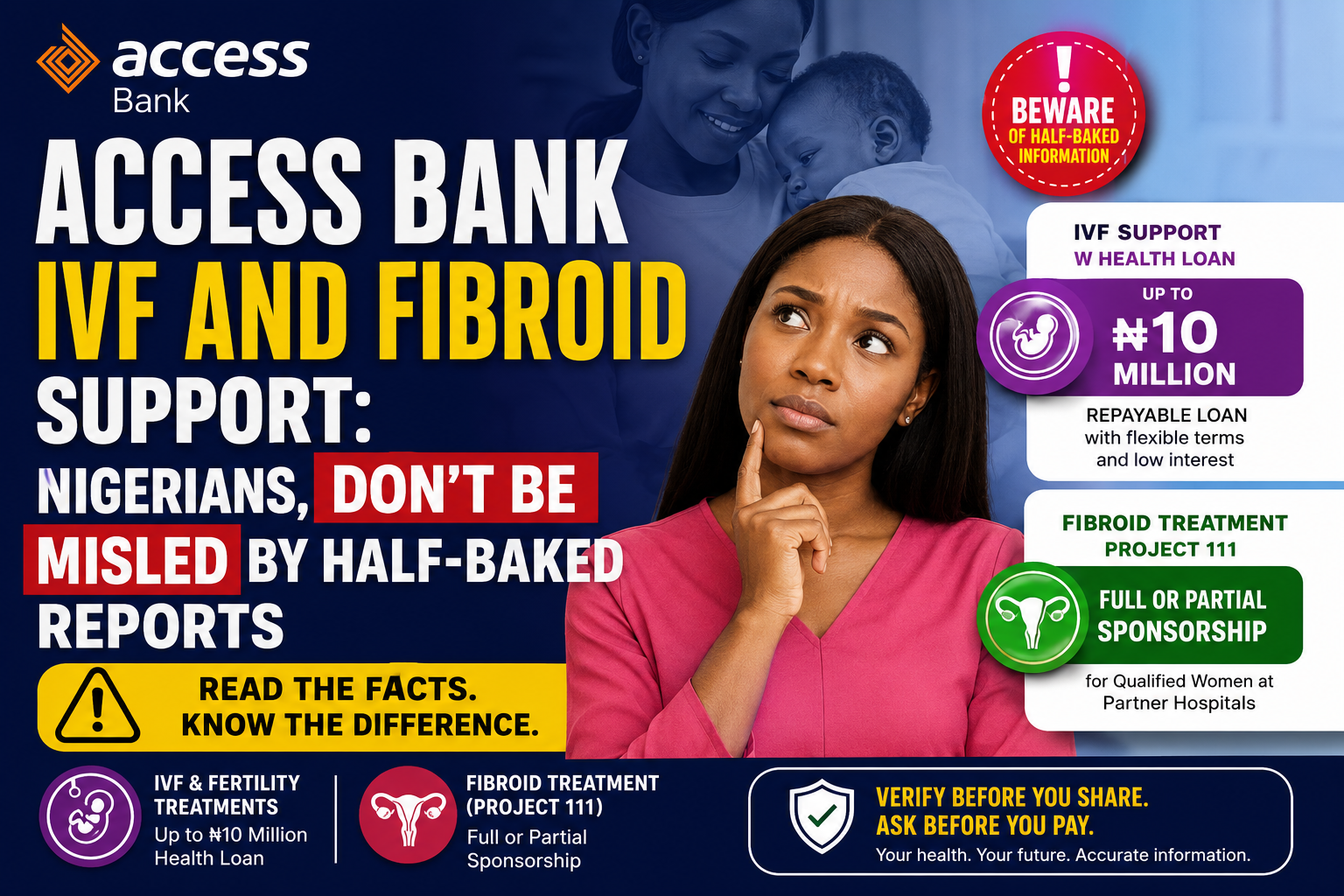
Access Bank IVF and Fibroid Support: Nigerians, Don’t Be Misled by Half-Baked Reports — Here’s What the Bank Is Really Offering Women.
By Babajide Moronfolu
There is encouraging news for Nigerian women struggling with the high cost of IVF, fertility treatment and fibroid treatment, but there is also an important warning:
Do not be misled by headlines or social media posts suggesting that Access Bank is simply giving every woman free money for IVF and fibroid surgery.
The truth is more specific.
Access Bank currently operates different health-support programmes, and confusing them could leave families with the wrong expectations.
For fertility treatments such as In Vitro Fertilization (IVF), Access Bank provides eligible applicants with access to a health loan of up to ₦10 million through its Maternal Health Service Support/W Health Loan programme.
That money is financing—a loan—not a general free cash grant.
For women requiring treatment for uterine fibroids, however, there is another programme known as Project 111, under which qualified women can be considered for full or partial sponsorship of fibroid treatment at designated partner hospitals.
That distinction is extremely important.
The Headline Many Nigerians May See
A headline such as:
“Access Bank Gives Women ₦10 Million for IVF and Fibroid Surgery”
would naturally attract attention.
It might also give a woman struggling to conceive the impression that she can walk into Access Bank, apply for ₦10 million, undergo IVF and never repay the money.
That is not what Access Bank's official information says.
The ₦10 million facility is a loan, subject to eligibility requirements, credit checks and repayment conditions.
There is, however, a separate fibroid programme where some eligible women may receive treatment sponsorship.
So Nigerian women need to know exactly which programme they are applying for.
Access Bank's IVF Support: What Is Actually Available?
Access Bank's Maternal Health Service Support (MHSS) is part of its wider W Initiative.
The bank describes MHSS as a discounted health-financing solution designed to give women and families easier ways of paying for medical procedures.
Among the procedures covered are:
- IVF and other fertility treatments
- Fibroid treatment
- Child delivery
- Paediatric care
- Dental and optical procedures
- Orthopaedic treatment
- Bariatric or weight-loss procedures
- Other specialized medical treatments
Access Bank currently advertises financing of up to ₦10 million for health procedures.
This can undoubtedly be valuable to families who desperately need fertility treatment but cannot immediately produce millions of naira to pay a hospital.
But Nigerians should understand the terminology:
This ₦10 million is a loan.
It is not automatically free money.
It is not a federal government grant.
It is not an IVF giveaway.
And receiving treatment does not mean the bank has permanently paid the bill on behalf of the beneficiary without repayment.
Access Bank itself calls it the MHSS Loan and lists features including a highly subsidized interest rate, flexible repayment plan and no loan fees.
What Does the Access Bank Health Loan Offer?
According to the bank, features include:
- Up to ₦10 million for qualifying healthcare procedures.
- A highly subsidized interest rate.
- No loan fees.
- A flexible repayment plan.
- No collateral requirement for qualifying salary earners.
- Flexible collateral arrangements for business owners.
- Access to a network of participating fertility clinics and other healthcare providers.
That makes the programme potentially significant for couples facing expensive fertility treatment.
IVF can be financially overwhelming, particularly when a couple requires more than one treatment cycle.
Access to structured financing could allow treatment to begin without the family having to produce the entire medical bill immediately.
However, borrowers remain responsible for meeting the bank's loan terms.
Can a Man Apply for the IVF Loan for His Wife?
Yes.
Another detail that deserves wider publicity is that an applicant does not necessarily have to be the woman receiving treatment.
According to Access Bank's official MHSS information, applications can come from:
- Women
- Men
- A third-party sponsor who meets the bank's requirements and is willing to obtain the facility on behalf of the woman or child requiring treatment.
Access Bank also says salary earners and business owners may apply if they meet the bank's criteria.
Therefore, a husband who meets the financial requirements may potentially obtain financing to pay for his wife's fertility treatment.
What Types of Fertility Treatment Can Access Bank Finance?
IVF is not the only fertility-related procedure included in Access Bank's maternal health programme.
The bank states that its financing has supported procedures including:
- In Vitro Fertilization — IVF
- Intrauterine Insemination — IUI
- Intracytoplasmic Sperm Injection — ICSI
- Gestational surrogacy
- Other fertility treatments
- Myomectomy
- Hysterectomy
- Treatment for endometriosis
The programme can support certain medical procedures carried out within Nigeria or internationally, subject to applicable conditions.
What Do You Need to Apply for the ₦10 Million Health Loan?
Access Bank currently lists several requirements for applicants.
These include:
- Completed MHSS loan application form
- Domiciliation of salary or business proceeds
- Employee status inquiry/employer confirmation where applicable
- Confirmation or promotion letter
- Employment identification
- Valid means of identification
- Medical bill from the hospital
- Referral letter from the hospital
- Bank Verification Number — BVN
- Credit checks
- Credible guarantor for business owners, where required
This alone demonstrates why describing the programme simply as “Access Bank gives women ₦10 million for IVF” can be misleading.
A person is applying for credit to finance healthcare, and the application is subject to financial assessment.
But Fibroid Patients Have Another Opportunity: Project 111
This is where the story becomes particularly interesting.
Apart from the W Health Loan, Access Bank operates Project 111, which specifically targets women requiring fibroid treatment.
Under Project 111, qualifying women may be considered for full or partial sponsorship of their treatment.
This is fundamentally different from obtaining the ₦10 million W Health Loan.
In simple terms:
IVF: generally financed through the Access Bank W Health/MHSS loan.
Fibroid treatment under Project 111: selected beneficiaries may receive full or partial sponsorship.
That is the distinction every woman reading stories about the programme should understand.
What Is Project 111?
Project 111 is Access Bank's fibroid-focused corporate social responsibility initiative.
Rather than simply lending money to every applicant, the programme works through selected healthcare institutions.
Women register their interest at a participating hospital, undergo medical assessment and may subsequently be considered for sponsorship.
According to Access Bank, eligibility requirements include being:
- A woman residing in Nigeria.
- Located reasonably close to a participating hospital.
- Medically fit for the recommended fibroid treatment.
- Willing to complete the treatment plan if selected.
- Willing to sign documentation relating to full or partial sponsorship.
Importantly, application does not automatically mean approval.
How Does a Woman Apply for Project 111?
Access Bank says applications for full or partial sponsorship are primarily handled by participating hospitals.
The process begins when an applicant visits a Project 111 partner hospital and registers her interest in becoming a beneficiary.
Medical investigations are then carried out so healthcare professionals can determine her condition and appropriate treatment.
Eligible patients can subsequently be shortlisted for consideration under the programme.
This means women should not assume that somebody advertising an “Access Bank fibroid grant” on WhatsApp or Facebook has the authority to register them privately.
The safest approach is to deal directly with an approved hospital or Access Bank.
Access Bank's Project 111 Partner Hospitals
The bank's current Fibroid Care Directory lists participating facilities in different parts of Nigeria, including:
Lagos
Fibroid Care Centre @ Nordica, Lekki
19A Chief Augustine Anozie Street, off Prince Adelowo Adedeji Street, off Admiralty Way, Lekki Phase 1.
Telephone:
0811 279 0508
0807 771 1459
01 453 2266
The centre provides fibroid care including HIFU treatment for appropriately selected patients.
Finnih Medical Centre, Ikeja
42 Oduduwa Crescent, GRA, Ikeja, Lagos.
Kwara State
Med Care Hospitals, Ilorin
182 Pipeline Road, adjacent CBN Quarters, Gaa-Akanbi, Ilorin.
Telephone: 0908 413 1959.
Plateau State
Fertile Ground Hospital Ltd., Jos
Plot 1234, adjacent Living Faith Church, Diye Zaramaganda, Jos.
Telephone: 0803 597 7944.
Sokoto State
Al-Nisah Hospital Ltd.
No. 5 Abdullahi Kure Road, off Kano Road, Sokoto.
Anambra State
Life International Hospital Ltd., Awka
Plot R 908752, Agu-Awka Industrial Estate, Awka.
Because hospital participation can change, women should verify the current list with Access Bank before travelling long distances.
So, Is Access Bank Paying for Fibroid Surgery?
Potentially yes—but only for qualifying beneficiaries under Project 111, and the support may be full or partial.
That is quite different from saying:
“Access Bank is giving every woman money for fibroid surgery.”
Project 111 involves an application and selection process.
The patient must be medically assessed, meet eligibility requirements and be selected for sponsorship.
Some beneficiaries may receive full sponsorship while others may receive partial support.
Is Access Bank Paying for IVF?
The terminology here is even more important.
Access Bank is helping women and families finance IVF, but its standard W Health/MHSS offering is a loan of up to ₦10 million, not a blanket free IVF sponsorship programme.
A woman seeing the word “support” should therefore not automatically interpret it as meaning “free treatment.”
Financial support can mean:
a loan, subsidized financing, a discount, partial sponsorship or full sponsorship.
These are not interchangeable terms.
Why Half-Baked Information Can Be Dangerous
There is a larger lesson here for Nigerians.
Social media has made information extraordinarily easy to distribute.
Unfortunately, it has also made incomplete information easy to spread.
A blogger may see:
“Access Bank — up to ₦10 million — IVF — fibroid treatment”
and immediately publish:
“BREAKING: Access Bank Giving Nigerian Women ₦10 Million for IVF and Fibroid Surgery.”
Technically, pieces of that headline may have come from a genuine programme.
But the overall impression could still be wrong.
The missing word is:
LOAN.
And in the case of Project 111, the missing explanation is:
FULL OR PARTIAL SPONSORSHIP FOR SELECTED FIBROID PATIENTS.
Those details could completely change a reader's understanding of the opportunity.
Nigerians Must Learn to Read Beyond Headlines
This story goes beyond Access Bank.
Health information is particularly sensitive because desperate families can make major financial or medical decisions based on what they read online.
Before acting on claims about grants, scholarships, loans, free surgeries or government programmes, readers should ask:
Who is the original source?
Is there an official website?
Is the money a grant or a loan?
Does it have to be repaid?
Who qualifies?
Are there participating hospitals?
What are the application requirements?
Has the programme expired?
Are there conditions that were omitted from the headline?
That extra verification could save someone from disappointment—or even fraud.
Beware of Fraudsters Using the Programme's Name
Because IVF and fibroid treatment can be expensive, women searching for assistance may be particularly vulnerable to scammers.
Be suspicious if anyone tells you:
“Pay me and I will put your name on the Access Bank list.”
Or:
“Send me money and I will guarantee your ₦10 million.”
Or:
“Give me your banking PIN or OTP to process your medical grant.”
Those should immediately raise red flags.
Access Bank states that applicants for the MHSS facility undergo a formal process, including medical documentation and credit checks.
Project 111 applications are similarly processed through approved partner hospitals.
Deal directly with the bank and participating healthcare providers.
What a Woman Seeking IVF Should Do
If you are seeking IVF financing, contact Access Bank and ask specifically about:
“The Maternal Health Service Support or W Health Loan for fertility treatment.”
Do not simply ask:
“Where can I collect the IVF money?”
Explain that you require financing for fertility treatment and ask the bank to explain:
- Your eligibility.
- Maximum amount you qualify for.
- Interest rate.
- Repayment period.
- Monthly repayment.
- Documentation required.
- Approved fertility clinics.
- Whether your preferred clinic is accepted.
- Any other charges or conditions.
Access Bank currently states that qualifying applicants can obtain up to ₦10 million, subject to the bank's terms.
What a Woman With Fibroids Should Do
If fibroids are the problem and affordability is the major obstacle, ask specifically about:
“Access Bank Project 111 Fibroid full or partial sponsorship.”
Contact an approved hospital and say:
“I have fibroids and I want to register for consideration under Access Bank's Project 111 fibroid treatment sponsorship programme. Please tell me the application and screening process.”
That wording immediately distinguishes Project 111 from the ordinary health loan.
The Good News Should Still Be Celebrated
Correcting misinformation should not diminish the importance of what Access Bank is doing.
The initiatives address a genuine problem.
For many Nigerian families, the barrier between a woman and IVF may be several million naira.
For another woman, years of heavy bleeding and pain from fibroids may continue because she cannot afford surgery or another recommended treatment.
A health loan that makes treatment immediately accessible can be life-changing.
A CSR programme that pays all or part of a woman's fibroid treatment can equally transform a life.
Access Bank says its Maternal Health Service Support initiative has already helped families access fertility care, and the bank reports that babies have been conceived and born following financial assistance provided through the programme.
Those are stories worth telling.
But they should be told accurately.
BabaCares Verdict: The Verified Facts
Here is the information Nigerians should remember:
Access Bank is NOT simply handing every Nigerian woman ₦10 million cash for IVF or fibroid surgery.
For IVF and other fertility treatments, Access Bank offers eligible applicants a repayable W Health/MHSS loan of up to ₦10 million, with subsidized interest, flexible repayment and applicable eligibility requirements.
For fibroid treatment, women may also apply separately under Project 111, where eligible and selected patients can receive full or partial sponsorship at participating hospitals.
These are two important opportunities.
But they are not the same programme.
One is principally healthcare financing that must be repaid.
The other can provide full or partial fibroid treatment sponsorship to selected beneficiaries.
So before sharing that viral headline with another woman, read beyond the headline.
And before rushing to a bank or hospital expecting free ₦10 million, verify exactly what programme you are applying for.
In an age when information travels around Nigeria in seconds, accuracy matters.
A half-truth about healthcare can sometimes be almost as dangerous as no information at all.
At BabaCares, our message remains simple:





Comments